Product Management Portfolio

AI-Powered Vietnamese Tech News Platform

An automated, AI-driven digital media platform designed to capture the Vietnamese tech news market. By treating traditional editorial workflows as a scaling problem, RetroLab maximizes content output to 50+ articles daily while driving operational costs to near zero with a custom multi-provider LLM pipeline.

0 Articles Published
0+ Sources Aggregated
$0.04 Cost Per 50 Articles
0 Categories

retrolab.com.vn
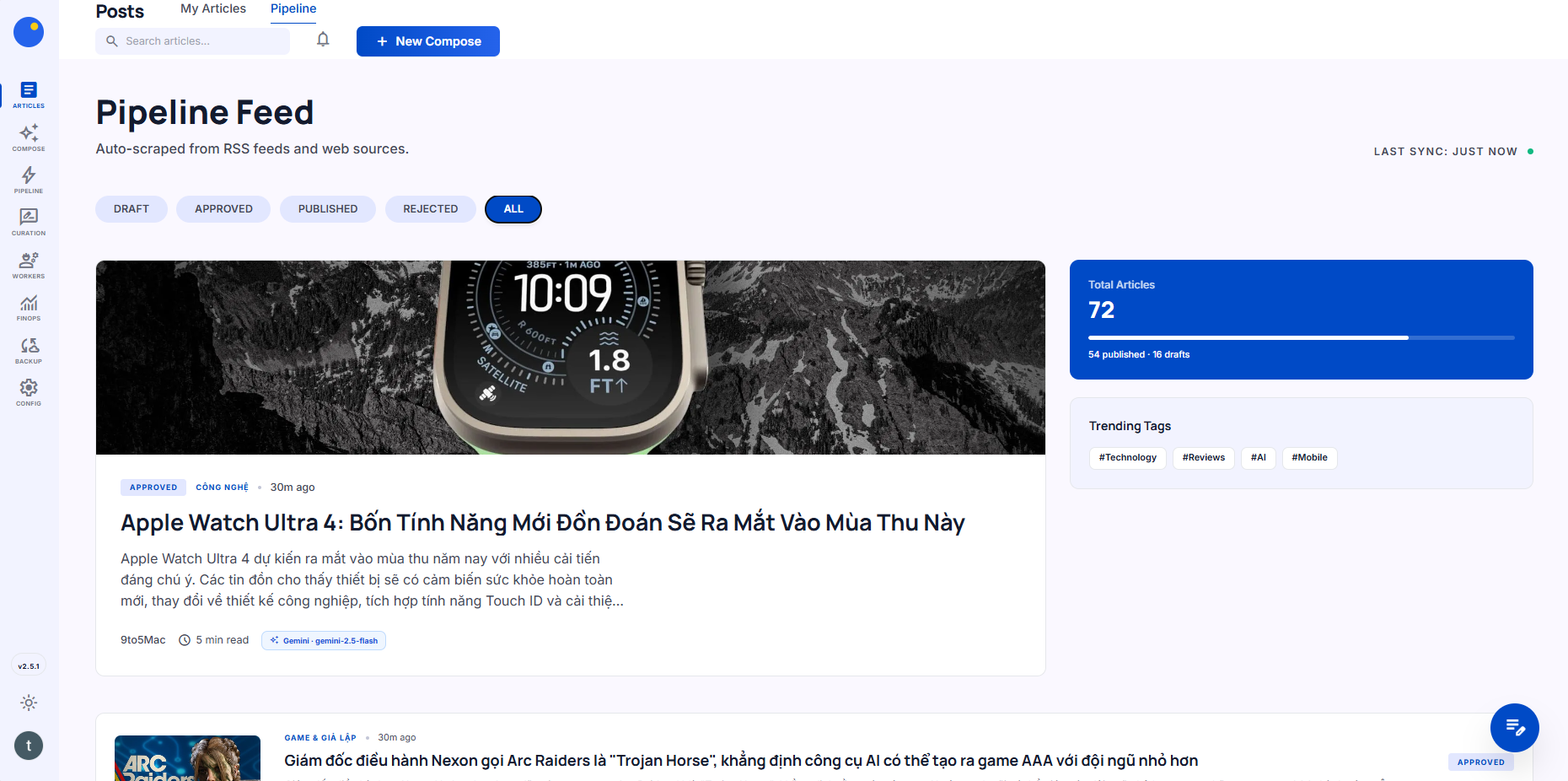
RetroLab.com.vn — Vietnamese Tech News Homepage

Why Build RetroLab?

Vietnamese tech enthusiasts lack a high-quality, centralized source of international technology news in their native language. Existing solutions rely on manual translation, are slow to update, and provide fragmented coverage.

Content Velocity

Tech news is highly perishable. By the time human editors translate a breaking story from English to Vietnamese, the 12-hour delay renders the article obsolete and kills SEO potential.

Unsustainable Margins

Scaling a traditional localized media site requires hiring armies of translators. The human cost per article destroys profitability, making high-volume coverage financially impossible.

Inefficient Discovery

Editors waste hours manually scouring dozens of fragmented international feeds (The Verge, TechCrunch) just to decide what to write about, bottlenecking actual production.

The Solution

End-to-End AI Automation

RetroLab replaces the traditional editorial headcount with a headless, multi-agent AI architecture. By automating discovery, curation, translation, and publishing, the system operates at a scale and speed that human teams cannot match, delivering high-quality localized content at virtually zero marginal cost.

~2min Source → Published
99% Automation Rate
$0.001 Per Article Cost

What Powers RetroLab

A deep dive into the key capabilities that make this platform tick.

01

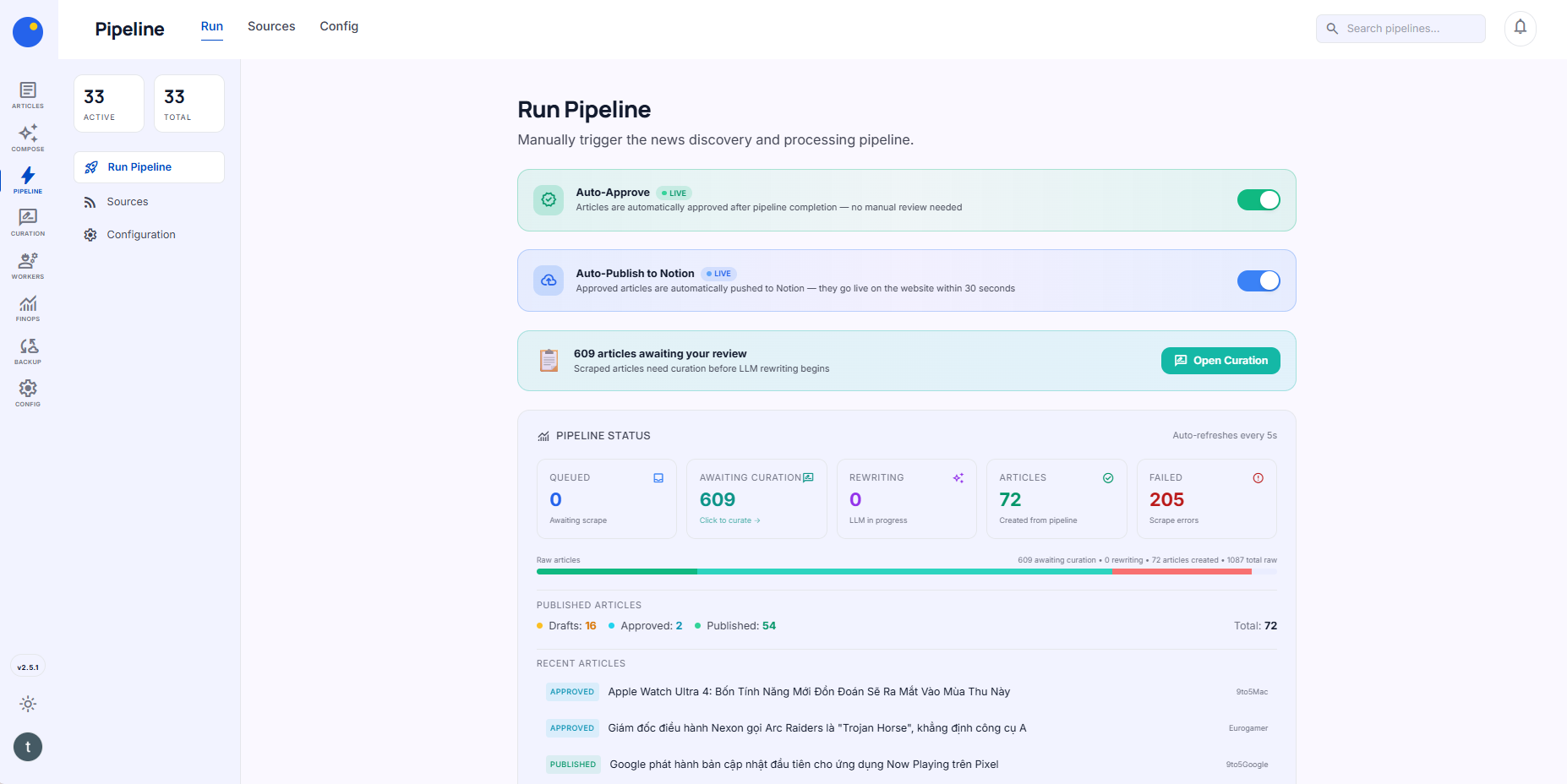
Automated AI Pipeline with Multi-LLM Routing

To make AI-generated content profitable, I designed a cost-aware AI strategy. Routine tasks (like categorization and tagging) are dynamically routed to free or local models, reserving paid, premium APIs strictly for complex, quality-critical rewriting.

  • Dynamic routing between Gemini, Claude, and Ollama
  • Intelligent deduplication & content quality scoring
  • Real-time FinOps tracking to monitor per-token cost and ROI per article
admin.retrolab.com.vn/pipeline
RetroLab Pipeline Dashboard — Multi-LLM routing and task monitoring
02

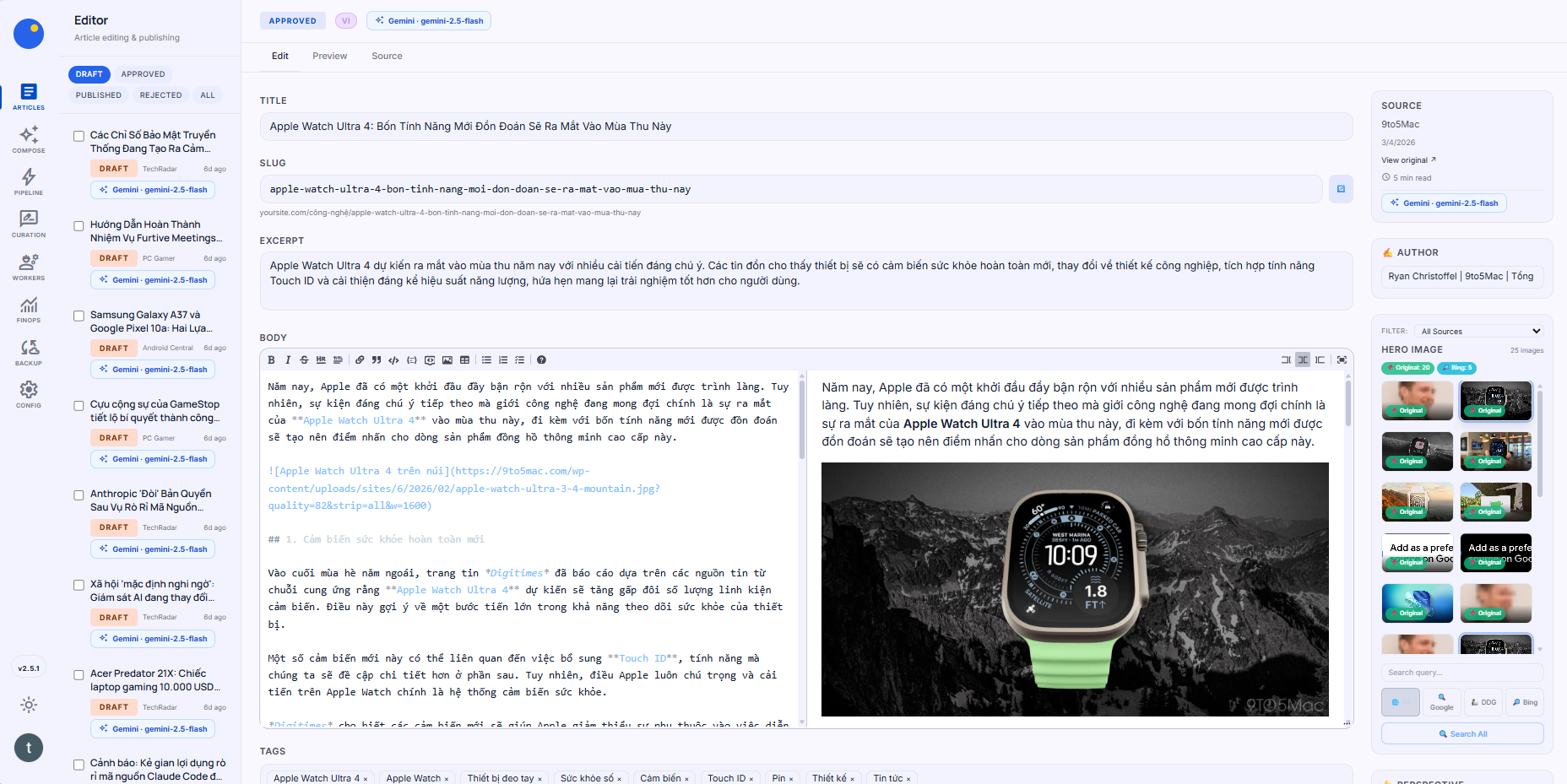
Zero-Friction Headless CMS

Instead of building a custom backend UI that editors had to learn, I strategically integrated Notion as the primary database. This enterprise-grade infrastructure reduced server overhead to zero and completely eliminated onboarding friction for the editorial team.

  • Familiar Notion interface for zero-training onboarding
  • Zero database hosting costs or maintenance overhead
  • Seamless sync to Next.js SSR frontend with ISR caching
admin.retrolab.com.vn/editor
RetroLab Editor — Full-featured Markdown editor with split-screen preview
03

90% Workflow Reduction

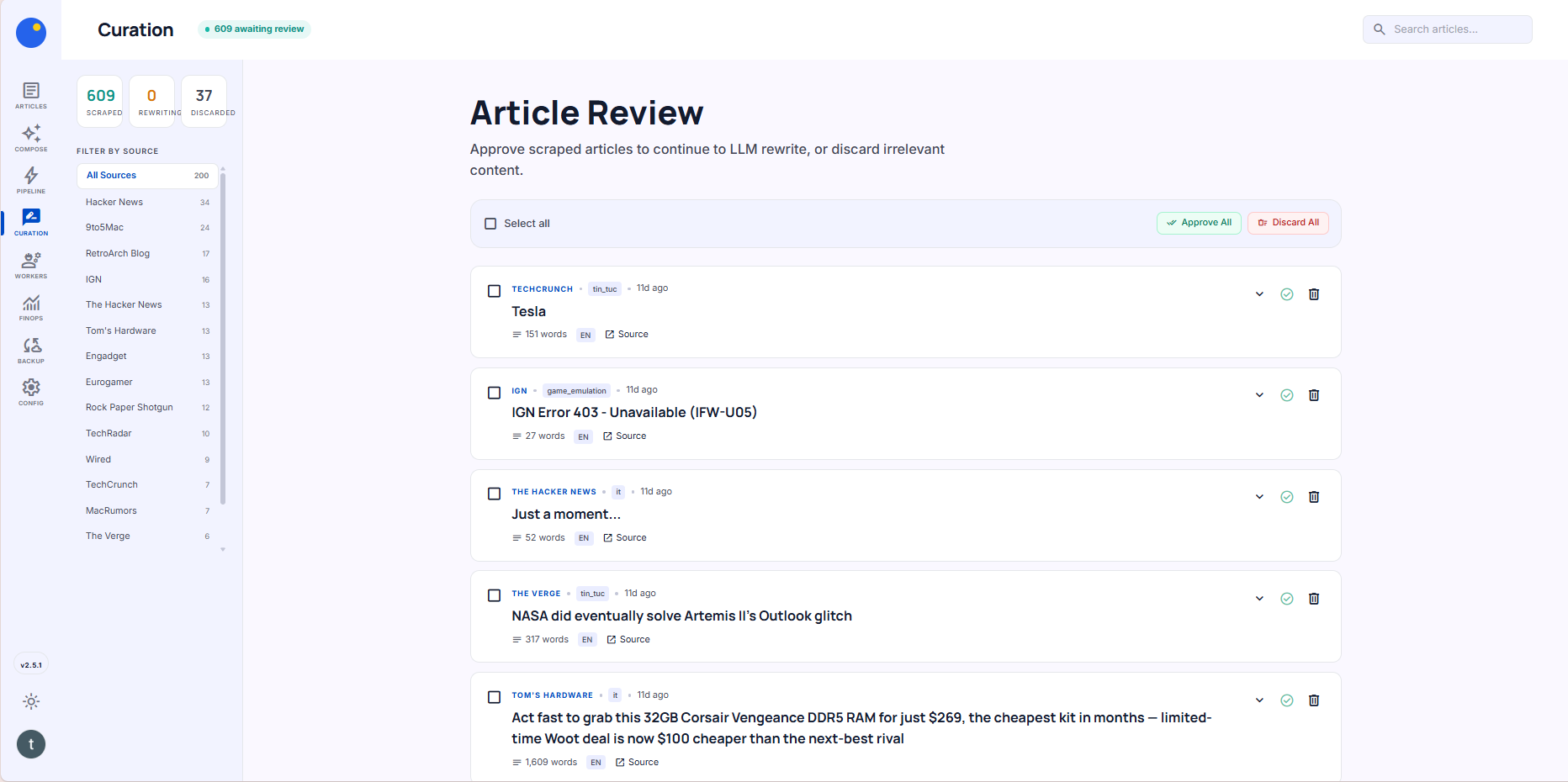
The custom pipeline handles automated localization instantly. English-language source articles are culturally adapted for Vietnamese readers, transforming a multi-hour manual translation process into a single-click "Approve" workflow for human editors.

  • LLM-powered cultural adaptation and contextual rewriting
  • Automated SEO optimization (titles, tags, summaries)
  • Human-in-the-loop queue for final quality control
admin.retrolab.com.vn/curation
RetroLab Curation Queue — Article review from 15+ sources with approve/discard workflow

Every Tool Chosen for a Reason

Each technology was selected to solve a specific product constraint — not just because it was popular.

Sources

RSS Feeds & Web Crawlers

Celery Workers

Scraper → Rewriter → Image

LLM Engine

Gemini / Claude / Ollama

Notion CMS

Content Storage & API

Next.js

SSR Public Frontend

Why Each Tool Was Chosen

Next.js 15

Chosen for server-side rendering. Critical for SEO performance in the competitive media space.

Notion API

Chosen to eliminate editor onboarding time. Zero training needed for a tool they already use daily.

Google Gemini + Claude

Multi-provider strategy to avoid vendor lock-in and dynamically route tasks to the cheapest capable model.

Celery + Redis

Chosen for resilient async task queuing. Ensures the pipeline never blocks on slow LLM API calls.

Docker Compose

Chosen for reproducible, zero-downtime deployments on a single VPS. Keeping infrastructure costs near zero.

PostgreSQL

Chosen as the source-of-truth for pipeline state and FinOps metrics. Enabling reliable cost analytics.

The Operational Engine

Behind retrolab.com.vn, the entire editorial operation runs on three interconnected systems. Each one was designed to eliminate a specific bottleneck in the content lifecycle.

admin.retrolab.com.vn/dashboard
RetroLab Dashboard — Full operational overview and human curation
Pipeline & Human Oversight

Automated Discovery with a Deliberate Quality Gate

The pipeline autonomously scrapes 15+ international RSS feeds, deduplicates content, and queues articles for processing. But full automation without oversight is reckless. The Curation Queue is a deliberate design choice: a single human decision point where an editor reviews, approves, or discards each article in one click before the AI rewriting engine takes over. This is the "human-in-the-loop" pattern that ensures editorial integrity at scale.

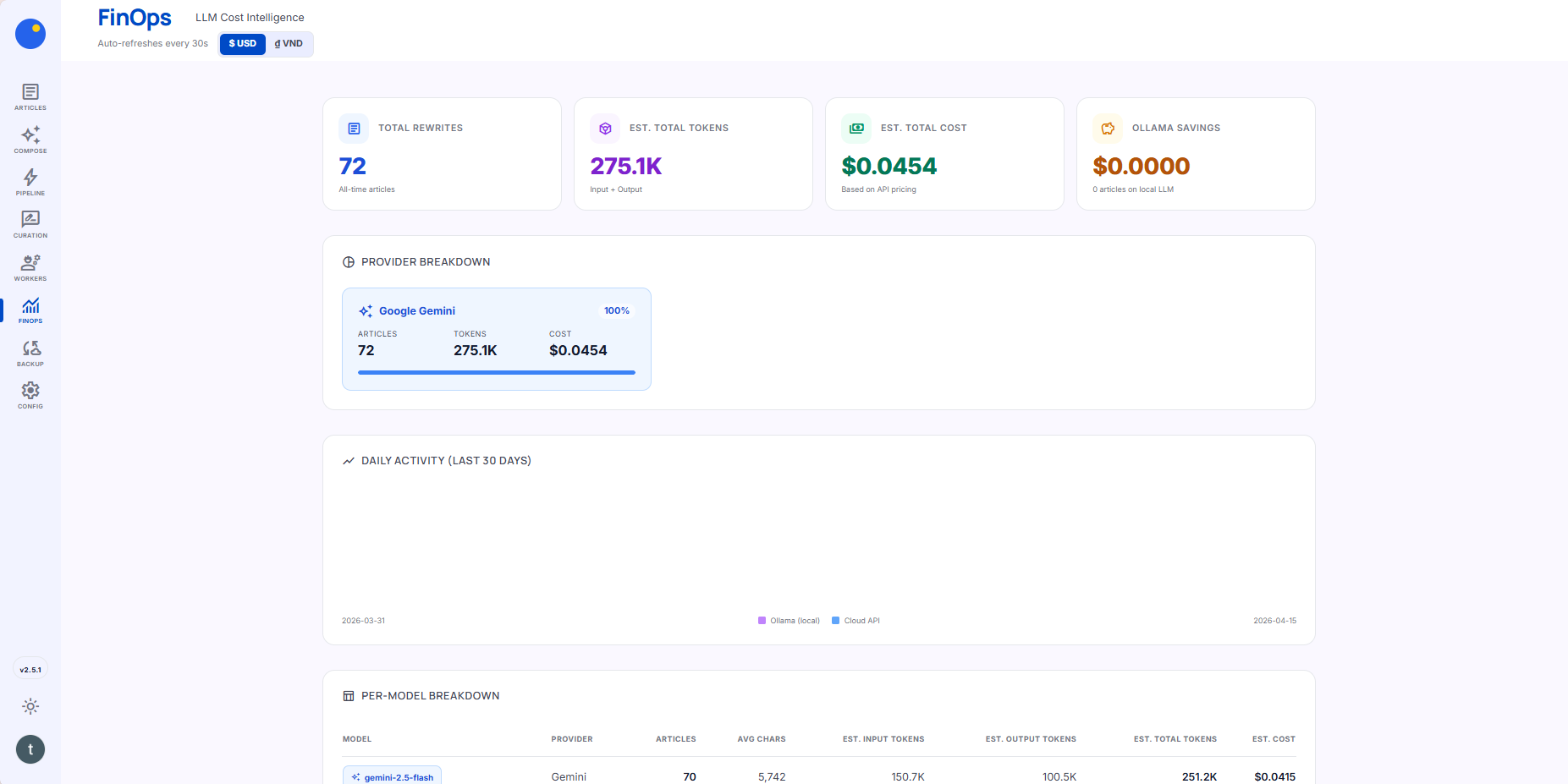
admin.retrolab.com.vn/finops
RetroLab FinOps Dashboard — Per-model token cost and ROI tracking
Unit Economics

FinOps — Real-Time Cost Intelligence

Proving the pipeline works is step one. Proving it's profitable is step two. The FinOps dashboard tracks per-model token spend across Gemini and Claude in real time, breaking down cost-per-article to the fraction of a cent. This is the tool that answers the single most important PM question: "At $0.001 per article, is the AI pipeline cheaper than hiring one junior editor?" The answer drives every routing decision in the system.

admin.retrolab.com.vn/editor
RetroLab Rich Content Editor — Split-screen Markdown with Notion sync
Zero-Friction Tooling

Rich Editor — Where Content Gets Polished

After an article clears the pipeline and passes curation, it arrives here. The editor provides a split-screen Markdown environment with live preview, inline AI-assisted rewriting, and one-click publish directly to Notion. By syncing with the Notion API as the content store, there is zero database hosting cost and zero onboarding friction — editors work in a tool they already know.

Measurable Outcomes

Key results that demonstrate the platform's effectiveness and efficiency.

50+
Articles/Day Capacity

Automated pipeline processes and publishes 50+ articles daily from 15+ international sources without manual intervention.

~2 min
Time-to-Publish

From source article detection to fully localized, SEO-optimized Vietnamese content published on the live site.

$0.001
Cost Per Article

Multi-provider LLM routing and free-tier optimization drive per-article cost to a fraction of a cent.

99%
Automation Rate

Only the curation step requires human input. Everything else from discovery to publishing is fully automated.

My Role & Contributions

Served as the sole Product Manager and Technical Architect, driving the platform from initial concept to live deployment.

Product Strategy

  • Defined the "0-to-1" product vision for a high-volume, low-overhead media platform
  • Defined the Vietnamese localization strategy to capture market share from slower, manual-translation competitors
  • Navigated resource constraints by leveraging free-tier APIs and headless integrations

End-to-End Execution

  • Owned the complete product lifecycle from initial architecture to live deployment
  • Bridged the gap between complex AI pipeline logic and a seamless CMS user experience
  • Architected the technical stack and managed the complete delivery cycle across frontend interfaces and backend APIs

Growth & Analytics

  • Designed a FinOps dashboard to aggressively track and optimize LLM token costs
  • Iterated on AI prompt engineering based on output quality and SEO performance
  • Defined success metrics and built internal dashboards to track content throughput, cost efficiency, and pipeline health

See It Live

Visit retrolab.com.vn to experience the fully automated platform firsthand.